When to Start Potty Training? How My Daughter's Development Map Read Her Readiness, Not the Calendar
I wasn't behind. I just didn't know how to tell if she was ready — and that not-knowing was the loudest part.
July 14, 2026 · 4 min read
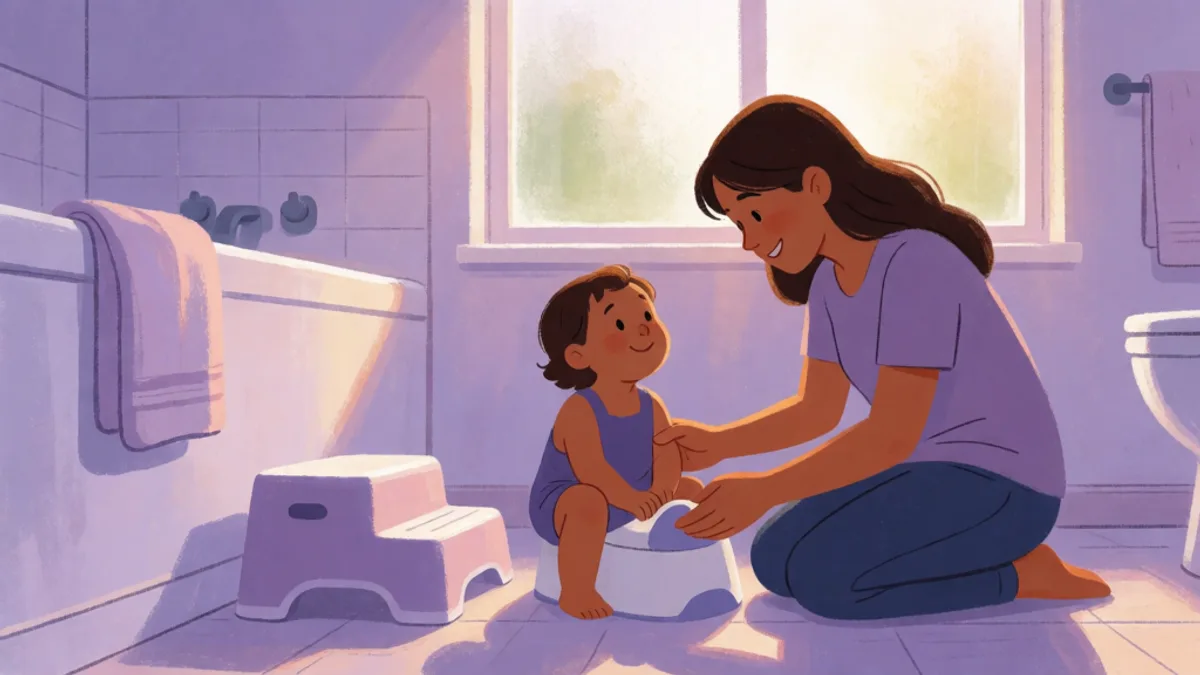
It started in a group chat. One mom said her son was fully out of diapers before he turned two. Another said she waited until almost three and it took a single weekend. Somewhere between those two messages I put my phone face-down on the counter and looked at my daughter — two months past her second birthday, methodically pulling every wipe out of the pack, one at a time.
And I thought: how am I even supposed to know? Not what age — I'd read enough numbers to last a lifetime. What I couldn't tell was whether Emma herself was actually ready, or whether I'd be starting something she just wasn't built for yet.
Everyone hands you a checklist. Nobody tells you where your kid is on it.
That's the trap with readiness. The internet is generous with signs — stays dry for two hours, tells you when she's wet, shows interest in the toilet — and every list quietly turns you into an examiner, standing over your own toddler trying to grade which boxes she ticks. My mother-in-law was sure the summer heat was "the sign." One parenting site said interest was everything; the next said interest meant nothing without bladder control. All true, all general, none of it about Emma.
What finally broke the spell wasn't advice. It was a friend, over lukewarm coffee, who said something so plain it stung a little: "You keep trying to spot the signs yourself. What if something just told you which ones she's already showing?" Not guess. Know.
She pointed me to one of those quick check-ins that walk you through the six areas kids grow across — motor, language, thinking, social-emotional, and the one I'd been circling without naming: self-care. That night, after Emma was asleep, I did it myself. Five minutes, and it didn't hand me a verdict. It handed me a map — not "is my kid behind," but "here's where your daughter actually is right now."
The map came back that same night, before I'd even closed my eyes:
Three of the five signs already map onto her. She stays dry for a couple of hours, she tells you the moment her diaper is wet, and she follows you in and narrates the whole routine. Her self-care and fine motor are right on track for her age, so pulling leggings down is well within reach.
This was never really about her age — Emma is already showing readiness. The science behind this — the Denver II's personal-social and self-care track, echoed by the SBP — treats readiness as gradual signs in the child, not a switch that flips on a birthday.
And it didn't stop at telling me she was ready. Underneath was a gentle two-week plan built around the signs Emma was already showing — hers, not a generic potty schedule off a blog. I won't reprint it here, because it was written for her, and it wouldn't fit your child. That was the whole point.
It wasn't that the science had gotten smarter. It was that Emma was in the answer at all — and that I could finally set down the examiner's clipboard. The signs I'd been anxiously hunting for, it turned out, were already there. She'd tell me the second her diaper was wet. She could pull her leggings halfway down. She'd trail me into the bathroom and narrate the whole thing like a tiny reporter. Not random. Her, waving little flags I'd been too busy counting months to notice.
The examiner in me had one last set of questions, of course, so here they are, answered: it took about five minutes, it comes with a 90-day money-back guarantee, and it never handed Emma a verdict or a label — it isn't a diagnosis, and it was honest about that: if something ever truly worried me, that's a conversation for her pediatrician, not a questionnaire. What it gave me instead was the thing the checklists never could — a read on the signs my own daughter was already showing.
I felt my shoulders come down for the first time in weeks — not because someone finally handed me the perfect sign to wait for, but because I had something better than a checklist: a way to see the ones my own daughter was already showing me. The question was never really "when do I start." It was "how do I tell whether she's ready right now." And that one, it turns out, has an answer.
What other parents said
Real notes shared by parents in firstk's parent meetings — not paid endorsements.
“I used to cry where my husband couldn't see me, sure something was wrong with my son. When I saw his map, I sat down and cried again — but from relief. He was doing well in almost everything. He just needed a nudge in one area, and the map showed me which.”
“I don't understand any of this development stuff — I never even finished school. But the questions are easy, everyday things. And the activities use what's already at home — a spoon, a pot, a ball. I didn't have to buy a thing.”
“What firstk gave me wasn't just the activities. It was sleeping peacefully, knowing I'm doing my part. I used to live with a tightness in my chest, that constant doubt. Now I know where he stands. That's priceless.”
About the firstk Method
Built by a school director after nine years inside early childhood — and proven in a non-profit school caring for children since 1973. Measure across 6 domains, act on a 90-day plan, re-measure every quarter.
The firstk assessment is a tracking and stimulation tool — it does not replace medical evaluation. If in doubt, consult a pediatrician.
Stop guessing. Measure.
From birth through age 4, the brain builds faster than it ever will again — and wherever your child is in that range, the window is open right now. Five minutes of questions, and the next advice you read will finally have your child inside it. 90-day guarantee.
Find out where my child stands →