The Supermarket Tantrum That Made Me Question Everything
It wasn't the screaming that undid me. It was the question I couldn't stop asking myself afterward.
July 14, 2026 · 5 min read
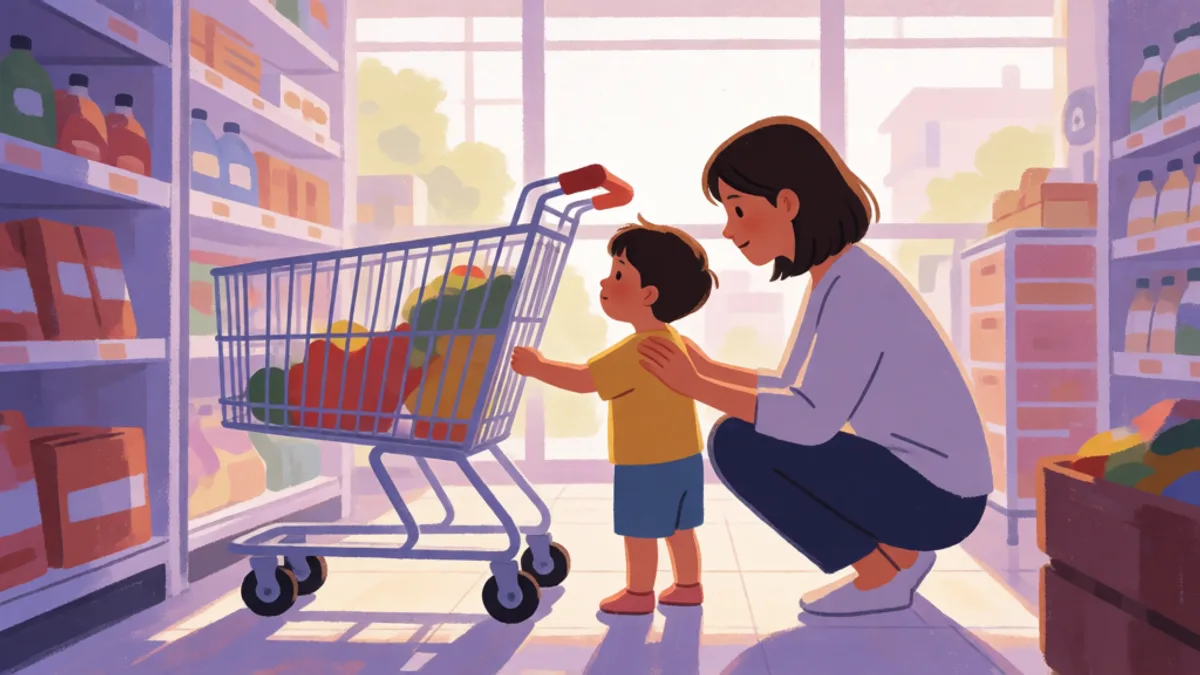
It happened in aisle six, somewhere between the cereal boxes and the juice.
One minute Noah was babbling to himself in the cart seat. The next he was arched backward, heels drumming against the cart, screaming loud enough that a man reaching for coffee actually turned to look. I tried a snack. I tried handing him my phone. I tried the low, even voice every parenting post swears by. None of it landed. So I left a half-loaded cart stranded in the middle of the aisle, hauled my red-faced, thrashing twenty-one-month-old onto my hip, and walked out to the parking lot with the back of my neck burning under everyone's eyes.
By the time I'd buckled him in, he was already sliding into that hiccuping, worn-out calm, and the store was behind us. The noise in my own head wasn't. Because the tantrum itself wasn't the part that stayed with me — it was the question that turned up the second it ended and refused to leave: is this just what a two-year-old does, or is something going on that I keep missing? I'd read the midnight articles, the ones that list what a meltdown "can be a sign of," and somewhere between the cart and the car I'd lost the ability to tell an ordinary hard moment apart from a warning I wasn't trained to catch.
I didn't need to be told to relax. I needed to be told about Noah.
Everyone had a line ready. "Tantrums are completely normal at this age." "You just have to stay firm." "He's testing you — don't give in." And the maddening thing is that all of it is true; it's the advice in every book. But it's built for every toddler who has ever screamed in a store, and I didn't want the general case. I wanted to know about Noah — the specific small person coming apart in my specific cart. None of the reassurance ever reached the part of me that lay awake.
A friend from my old prenatal group is the one who finally handed me something to hold. Not one of those instant-diagnosis quizzes that fire back a label — a real questionnaire about our ordinary days: how he handles a "no," how he plays near other kids, what tips him over the edge and how he climbs back — across all six areas of development at once, the social-emotional one included. It took about five minutes, one night after he was down. Nothing to grade. By the end it hadn't scored him. It had mapped him.
The map was waiting for me before I'd even closed the tab.
Social-emotional — right where you'd expect for nineteen to twenty-four months. He plays alongside other kids, he's begun testing limits, and his big feelings arrive fast and burn out fast. That's exactly the stage where self-regulation is still coming online.
Worth watching: the supermarket meltdowns probably aren't random — look at when they hit. Shopping late in the morning or close to his nap walks a hungry, tired toddler into bright lights, noise, and a wall of things he wants and can't have. That's a heavy load for a brain still learning to steady itself.
And it didn't stop at the pattern. Underneath was a 90-day plan built around Noah's exact triggers — his timing, his tipping points — woven into the trips we already make, not a generic list of tantrum tips. I won't copy it out here, because it was written for him, and it wouldn't fit your child. That was the whole point.
It wasn't that this was smarter than the internet. It was the same developmental science — the Denver II, the screening pediatricians actually use — only this time it had run through Noah first: his stage, his timing, his fast-in, fast-out feelings, sitting right inside the page. That was the shift. I'd stopped collecting advice about toddlers and started getting a read on mine.
And the wary part of me — the one who doesn't hand over money without knowing what she's getting — had her questions, so let me answer them plainly: it took about five minutes, it comes with a 90-day money-back guarantee, and it never once told me Noah was "behind" or handed me a label. It isn't a diagnosis, and it said as much: if his meltdowns ever truly worried me, that's a conversation for his pediatrician, not an app. What it gave me instead was the one thing all those midnight lists couldn't — a read on my own kid, with his name in it.
The next grocery run wasn't magic; he's still a toddler, and he still wobbled by the freezer aisle. But I walked in with a plan that had his name on it — built around his triggers, not a generic toddler's. And when I watched his face begin to crumple, I got down low and named it before it turned into a scream. My shoulders don't climb toward my ears anymore when he starts to fuss in a store — not because he never melts down, but because I finally have a picture of my own kid instead of the pile of worst-case guesses I used to gather at midnight. The meltdowns were never really the thing I couldn't handle. It was the not-knowing. And that, at last, has a shape.
What other parents said
Real notes shared by parents in firstk's parent meetings — not paid endorsements.
“I used to cry where my husband couldn't see me, sure something was wrong with my son. When I saw his map, I sat down and cried again — but from relief. He was doing well in almost everything. He just needed a nudge in one area, and the map showed me which.”
“I don't understand any of this development stuff — I never even finished school. But the questions are easy, everyday things. And the activities use what's already at home — a spoon, a pot, a ball. I didn't have to buy a thing.”
“What firstk gave me wasn't just the activities. It was sleeping peacefully, knowing I'm doing my part. I used to live with a tightness in my chest, that constant doubt. Now I know where he stands. That's priceless.”
About the firstk Method
Built by a school director after nine years inside early childhood — and proven in a non-profit school caring for children since 1973. Measure across 6 domains, act on a 90-day plan, re-measure every quarter.
The firstk assessment is a tracking and stimulation tool — it does not replace medical evaluation. If in doubt, consult a pediatrician.
Stop guessing. Measure.
From birth through age 4, the brain builds faster than it ever will again — and wherever your child is in that range, the window is open right now. Five minutes of questions, and the next advice you read will finally have your child inside it. 90-day guarantee.
Find out where my child stands →