I thought he was just a late talker — until his development map gave me a real answer
A story about the quiet uncertainty every parent knows — and the small thing that finally gave it edges.
July 7, 2026 · 3 min read
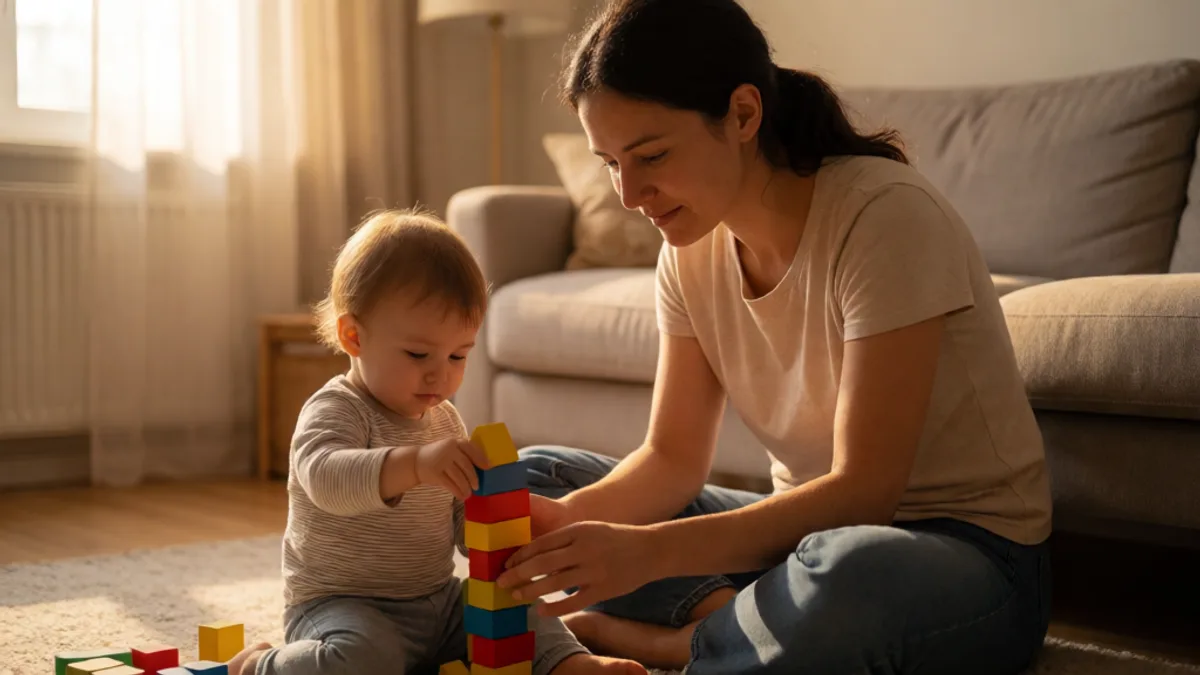
By his second birthday, the other toddlers in our playgroup were already stringing words together. Theo wasn't. He'd babble, point at the dog, hand me a cup — but actual words? Only a handful. Everyone had a reason ready: "boys talk later," "he'll get there when he's ready," "my nephew didn't say a thing until he was three." And maybe they were right. But standing in the kitchen one night after he'd gone down, I kept circling the same question I'd already pushed away twice that week: should I be doing something, or am I overthinking this? It wasn't panic. It was that low, shapeless not-knowing that doesn't point anywhere in particular — which is exactly why it wouldn't leave.
"He'll get there" is probably true. It just isn't about your kid.
The reassurance was kind, and it might even have been right. But it was advice for every two-year-old on earth — and I wanted to know about Theo. Every checklist I found online either told me everything was fine or sent me straight to the worst case. Nothing in between. Nothing that actually looked at my own kid — where he was doing well, and the one or two places worth a closer look.
I didn't want a score. I wanted a picture — where he was doing well, and the one or two places worth watching.
A friend told me about a different way to get one. Not one of those instant quizzes that fire back a diagnosis — a real read on Theo. It took about five minutes, one night between bath and bed: a series of plain questions about what he can already do and what he can't yet, across all six areas of development — not just the talking. At the end I didn't get a score. I got a map — where he was doing well, and where to look closer.
It came back that same night, before he was even asleep.
Gross motor, fine motor, and cognitive — all within range for his age.
Expressive language — the area to watch. He still uses only a few words with clear intent and rarely points to ask for what he wants. This isn't a race he's losing — the Denver II, one of the frameworks pediatricians actually use, treats language at this age as a skill you draw out with opportunities, not a milestone he's failing to hit.
And it didn't stop at naming it. Underneath was a 90-day plan built around that one gap — Theo's, folded into the ordinary moments of our day, not a tip I could've pulled off any list. I won't reprint it here, because it was written for him, and it wouldn't fit your child. That was the whole point.
The difference wasn't that some algorithm was smarter than the internet. It was that my son's name was inside the answer — a real picture of Theo, not of two-year-olds in general.
And the wary part of me — the one who doesn't hand over money without knowing what she's getting — had her questions, so let me answer them plainly: it took about five minutes, it comes with a 90-day money-back guarantee, and not once did it tell me Theo was "behind" or hang a label on him — it isn't a diagnosis, and it said so plainly: if something ever truly worried me, that's a conversation for his pediatrician, not an app. What it gave me instead was the one thing all those late-night searches never had — a next step with his name on it.
I felt my shoulders drop in a way I hadn't realized they'd been up — not because anyone promised me everything was perfect, but because, for the first time in months, the picture had edges, and Theo was inside them. The next morning, at bath time, I held up the duck and waited. He didn't say it. I held it up again. And he looked at me like he'd just figured out the rules of a game.
What other parents said
Real notes shared by parents in firstk's parent meetings — not paid endorsements.
“I used to cry where my husband couldn't see me, sure something was wrong with my son. When I saw his map, I sat down and cried again — but from relief. He was doing well in almost everything. He just needed a nudge in one area, and the map showed me which.”
“I don't understand any of this development stuff — I never even finished school. But the questions are easy, everyday things. And the activities use what's already at home — a spoon, a pot, a ball. I didn't have to buy a thing.”
“What firstk gave me wasn't just the activities. It was sleeping peacefully, knowing I'm doing my part. I used to live with a tightness in my chest, that constant doubt. Now I know where he stands. That's priceless.”
About the firstk Method
Built by a school director after nine years inside early childhood — and proven in a non-profit school caring for children since 1973. Measure across 6 domains, act on a 90-day plan, re-measure every quarter.
The firstk assessment is a tracking and stimulation tool — it does not replace medical evaluation. If in doubt, consult a pediatrician.
Stop guessing. Measure.
From birth through age 4, the brain builds faster than it ever will again — and wherever your child is in that range, the window is open right now. Five minutes of questions, and the next advice you read will finally have your child inside it. 90-day guarantee.
Find out where my child stands →