My 14-Month-Old Isn't Walking Yet — Here's What Finally Calmed Me Down
The doubt wasn't loud. It just sat there every night while everyone else's baby seemed to be taking off.
July 20, 2026 · 4 min read
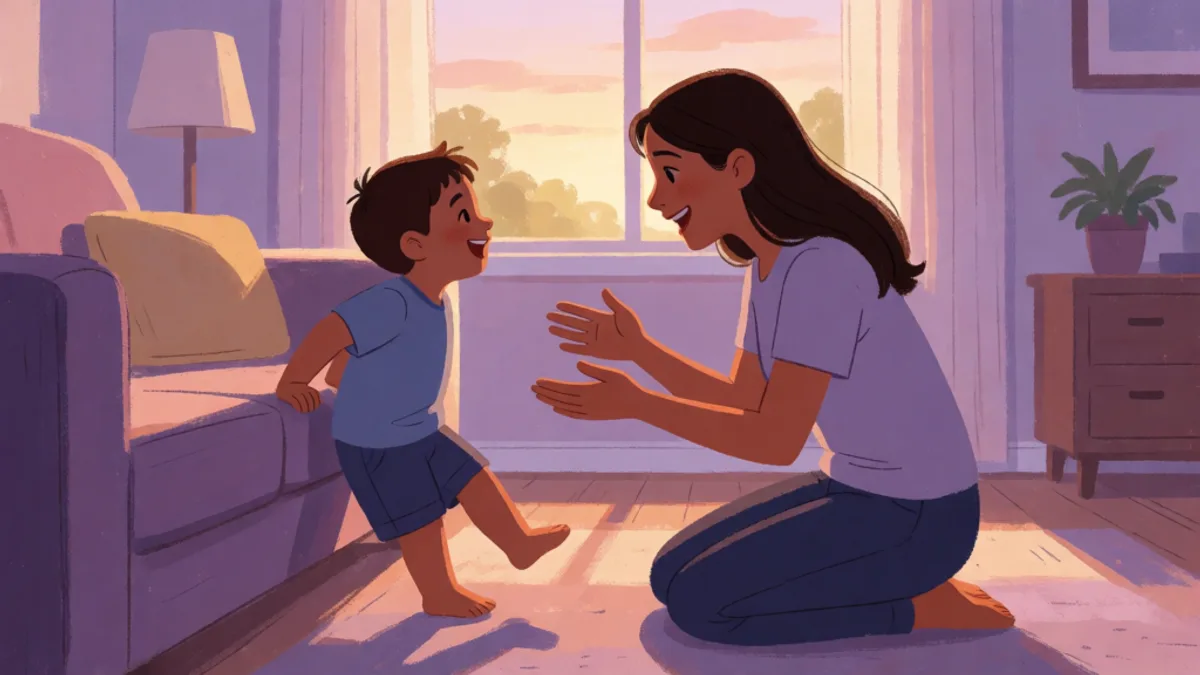
It always hit me right after I put him down for the night. The house went quiet, and the question came back: shouldn't he be walking by now? Liam was fourteen months. He'd pull up on the couch, cruise sideways along it, plop down, and crawl off like he had somewhere better to be. But those first real steps — the ones I kept seeing on other people's feeds, the ones his cousin took at eleven months — just weren't coming. And every time I got close to relaxing, someone at daycare pickup would ask, all bright and casual, "Oh, is he walking yet?"
Everyone told me the same thing. "Every child has their own pace." And you know what? They're right. It's true. But it's the kind of true that floats about a foot above your head and never actually lands. It's a fact about children, plural, all of them, somewhere out there. It says nothing about the specific little boy asleep down the hall — my Liam, with his own arms and legs and stubborn little personality. "Every child has their own pace" doesn't look at your child. And that gap, that space between the reassurance and my actual kid, is exactly where I kept lying awake.
So one night, instead of scrolling, I did something small. I answered a set of questions about Liam — took maybe five minutes — the kind that walk through what he actually does. Does he pull to stand? Does he cruise? Does he point at things he wants? How many words does he really use? It wasn't a quiz I could pass or fail. It was more like getting a real read on him first — his development mapped across six areas, not just the one everyone at pickup kept asking about — so that whatever came back would be about him, not about babies in general.
The map came back before I'd even set my phone down. Six areas, in plain language, with his name in the first line:
Gross Motor — right in the expected range for 14 months. The pulling-to-stand and the sideways cruising you described are exactly the pre-walking steps that come before independent walking.
Language — the one to watch. Fewer words than we'd typically look for in this window, and pointing-to-request hasn't shown up yet.
And it didn't stop at flagging it. Underneath was a two-week plan built around that one thing — small moves folded into the parts of our day we were already living, not a generic tip I could've found on any list. I won't copy it out here, because it was written for Liam, and it wouldn't fit your child. That's the whole point of a map with a name on it.
I read it twice. Not because it promised me he'd walk by Friday — it never promises that. But it had his name in the first line. It looked at the whole picture, six areas, not just the one visible thing everyone kept asking about. And it quietly confirmed the thing I was panicking over was fine, while flagging something quieter I hadn't even been watching.
The science behind it isn't mysterious, by the way. Screening tools like the Denver II have always looked at walking as one thread inside gross motor development, right alongside language, fine motor, social-emotional, cognitive, and self-care. "Walking and talking on time" is just the part you can see from across the room. It was never the whole child.
And the skeptic in me had her questions ready, so I'll answer them the way I wish someone had answered mine: it took about five minutes, it comes with a 90-day money-back guarantee if it doesn't turn out to be worth it, and it never once called Liam "delayed" or pinned a label on him — it isn't a diagnosis. It was clear about that: if something ever genuinely worried me, that's a conversation for his pediatrician, not a questionnaire on a screen. What it handed me instead was the thing no midnight article ever did — a next step with my son's name on it.
My shoulders came down that night — not because anyone told me Liam was perfect, and not because I finally decided to "just relax." They came down because, for the first time, what was on my screen actually had my son inside it. The doubt didn't win. It just got specific enough to do something with.
What other parents said
Real notes shared by parents in firstk's parent meetings — not paid endorsements.
“I used to cry where my husband couldn't see me, sure something was wrong with my son. When I saw his map, I sat down and cried again — but from relief. He was doing well in almost everything. He just needed a nudge in one area, and the map showed me which.”
“I don't understand any of this development stuff — I never even finished school. But the questions are easy, everyday things. And the activities use what's already at home — a spoon, a pot, a ball. I didn't have to buy a thing.”
“What firstk gave me wasn't just the activities. It was sleeping peacefully, knowing I'm doing my part. I used to live with a tightness in my chest, that constant doubt. Now I know where he stands. That's priceless.”
About the firstk Method
Built by a school director after nine years inside early childhood — and proven in a non-profit school caring for children since 1973. Measure across 6 domains, act on a 90-day plan, re-measure every quarter.
The firstk assessment is a tracking and stimulation tool — it does not replace medical evaluation. If in doubt, consult a pediatrician.
Stop guessing. Measure.
From birth through age 4, the brain builds faster than it ever will again — and wherever your child is in that range, the window is open right now. Five minutes of questions, and the next advice you read will finally have your child inside it. 90-day guarantee.
Find out where my child stands →